HMT-SLAM

This page overviews the theoretical foundations of the Hybrid Metric Topological (HMT) SLAM framework. For details about the implementation in the MRPT C++ libraries, see mrpt-hmtslam.
1 Overview
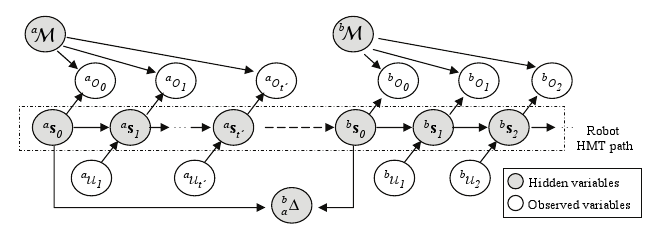
HMT-SLAM stands for Hybrid Metrical-Topological SLAM. It is a complete, consistent bayesian formulation of the SLAM (Simultaneous Localization and Mapping) problem that copes both with metrical and topological maps. Up to the first published paper of HMT-SLAM (see [1] below), all the intents to include topological information into classical metrical SLAM dealt with topologies as a separate component from metrics, and therefore use different techniques for processing both of them. In HMT-SLAM, however, both parts are dealt with in a unified probabilistic framework, which facilitates the integration of low-level, subsymbolic (metrical) algorithms with high-level, symbolic (topological) reasoning.

Like most successful works on SLAM, we use Bayesian filtering to provide a probabilistic estimation which can cope with uncertainty in the measurements, the robot pose, and the map. Our approach is based on the reconstruction of the robot path in a hybrid discrete-continuous state space, which naturally combines metric and topological maps. There are two fundamental characteristics of HMT-SLAM that set it apart from previous works:
- the use of a unified Bayesian inference approach both for the metrical and the topological parts of the problem, and
- the analytical formulation of belief distributions over hybrid maps, which allows us to maintain the partial uncertainty in large spaces more accurately and efficiently than previous works.
This method ideas has been validated by promising experimental results in large environments (up to ~30.000 m2, a 2Km robot path) with multiple tested loops, which could hardly be managed appropriately by other approaches.